

❤️☀️Love and Light☀️❤️
There is a deep way in which the concepts of Light and Love can be understood as describing similar patterns of relationship, connection, and life.
The first thing to notice is that both words are often used to describe something that unites rather than divides.
Light is what allows things to become visible. It reveals relationships between objects. Without light, forms disappear into obscurity. Light makes connection possible because it allows awareness, perception, and interaction.
Love, in its broadest sense, is also a force of connection. Love draws individuals, families, communities, and even species into cooperative relationships. Love reduces separation and increases participation in a larger whole.
In this sense, both light and love can be viewed as metaphors for relationship.
A philosopher might say: Light connects things through visibility. Love connects things through meaning.
Light allows a flower and a bee to find each other. Love allows a parent and child to care for each other. Both are forms of connection.
From a biological perspective, the connection becomes even more interesting.
The Sun powers photosynthesis. Photosynthesis produces food. Food supports life. Life gives rise to nervous systems, consciousness, emotion, attachment, empathy, and what humans call love.
Without sunlight, there would be no plants. Without plants, there would be no complex animal life. Without complex life, there would be no human affection, compassion, friendship, or love. Thus, one could poetically argue:
Light becomes life, and life becomes love.
The chain looks something like this:
Light → Energy → Life → Consciousness → Relationship → Love
Under this view, love is not separate from light but one of its highest biological and psychological expressions. There is also a symbolic dimension found across many civilizations. The Sun has frequently been associated with life, generosity, warmth, fertility, growth, healing, truth, and order. These are many of the same qualities that people associate with love.
Light nourishes. Love nourishes.
Light reveals. Love understands.
Light warms. Love comforts.
Light enables growth. Love enables growth.
Because the patterns are similar, cultures repeatedly linked them together. The opposite pairings also share similarities:
Light = Visibility, Awareness, Growth and Connection.
Darkness = Obscurity, Ignorance, Stagnation and Separation.
Love = Connection, Care. Cooperation and Unity.
Hate = Division, Harm, Conflict and Alienation.
This is why many spiritual traditions use light as a symbol for love and love as a symbol for light. However, there is an important distinction.
In physics, darkness is simply the absence of visible light. But hate is not merely the absence of love. Hate is an active emotional state, whereas indifference would be closer to the absence of love. So the analogy is powerful, but not exact. A deeper philosophical formulation might be:
Light is the physical principle that enables life to emerge and connect with its environment. Love is the conscious principle through which living beings recognize and preserve those connections.
Under this view, light and love are not identical things, but they describe the same underlying pattern at different levels of reality.
At the physical level, light creates and sustains the conditions for life.
At the biological level, life develops interdependence.
At the psychological level, interdependence becomes affection, empathy, and care.
At the ethical level, care becomes love.
So one could summarize the relationship this way:
Light is the foundation of connection in the physical world.
Love is the experience of connection in the conscious world.
Or more poetically:
Light is how the universe touches life. Love is how life touches itself.
In that sense, many philosophical and spiritual traditions have regarded love as the inner expression of the same connective principle that light expresses outwardly. Whether one interprets that literally, symbolically, metaphysically, or poetically, both words point toward a common theme: the movement from separation toward relationship, from isolation toward participation, and from fragmentation toward wholeness.
Literally
Light physically connects the Earth into a living system.
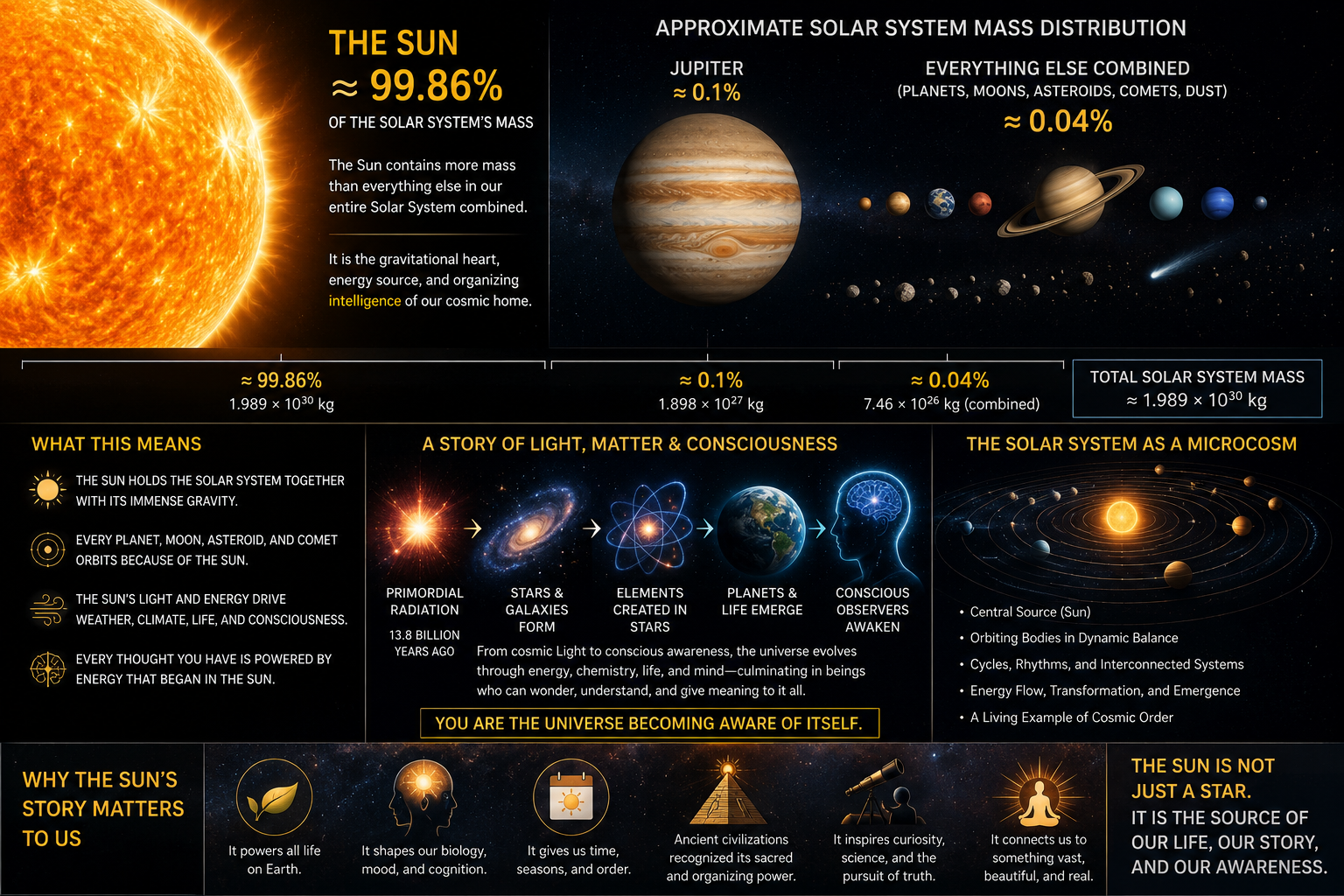
The Sun drives weather, climate, photosynthesis, ecosystems, food webs, and biological rhythms. Oceans, forests, clouds, winds, animals, and humans all participate in one interconnected planetary process powered primarily by solar energy.
Love, in the literal human sense, connects individuals into families, communities, and civilizations. Both describe networks of relationship.
Scientifically
Light is not merely something we see. It is the primary energy source for almost all life on Earth.
The Sun drives evaporation, cloud formation, rainfall, winds, ocean currents, plant growth, and the energy chains that sustain life.
Even weather itself is a grand expression of solar interconnection.
A cloud is connected to an ocean. A river is connected to a mountain.
A forest is connected to sunlight. A human is connected to all three.
Likewise, love can be understood scientifically as the biological and psychological mechanisms that create social cohesion, cooperation, attachment, empathy, and survival.
Light creates interconnected ecosystems. Love creates interconnected societies.
Logically
Anything that increases relationship tends toward greater coherence. Anything that increases separation tends toward greater fragmentation.
Light increases information. Love increases understanding.
Darkness obscures. Hatred divides.
Both light and love can be understood as forces that reduce isolation and increase participation in larger systems.
Symbolically
Across cultures, light symbolizes truth, wisdom, life, awareness, and harmony.
Love symbolizes compassion, unity, care, and belonging. The symbolism overlaps because both point toward connection.
A candle illuminating a room becomes a symbol of understanding. An act of kindness illuminating a life becomes a symbol of love.
Both "light up" what was previously disconnected.
Metaphysically
Many philosophical traditions have viewed reality as an interconnected whole.
Under this perspective, light represents the principle by which existence becomes manifest and visible.
Love represents the principle by which existence recognizes its unity with itself.
In this interpretation: Light reveals the interconnectedness of reality. Love experiences the interconnectedness of reality.
Poetically
The weather offers a beautiful example.
Sunlight warms the oceans. The oceans rise into clouds. The clouds become rain. The rain feeds rivers.
The rivers nourish forests. The forests release oxygen. The oxygen sustains animals and people.
Everything participates in everything else. Nothing exists alone.
Love can be viewed similarly. One act of care inspires another. One generation nurtures the next.
One friendship influences a community. One kindness ripples outward.
Like sunlight becoming weather, love becomes relationship. Like rain returning to the sea, relationship returns to wholeness.
Ethically
When people speak of love as an ethical principle, they usually mean actions that increase well-being, cooperation, understanding, and flourishing.
These actions tend to create greater coherence within human systems.
Hatred, cruelty, exploitation, and deception tend to produce fragmentation and disorder.
Ethically speaking: Love is the practice of increasing connection.
Just as sunlight continuously nourishes and integrates Earth's living systems, love continuously nourishes and integrates human systems.
In that sense, whether one speaks literally, scientifically, logically, symbolically, metaphysically, poetically, or ethically, light and love repeatedly converge upon the same pattern: Coherence.
The emergence of relationship. The participation of parts within a greater whole. The movement from isolation toward connection.
The movement from fragmentation toward wholeness. The realization that nothing truly exists by itself, but through its relationships with everything around it.
Light is the physical language of that interconnection.
Love is the conscious experience of that interconnection.
✨ The Book of Light - Synopsis ✨
The Book of Light is a vast interdisciplinary philosophical, scientific, symbolic, and civilizational work exploring Light as the foundational reality underlying existence, consciousness, life, ethics, memory, culture, and cosmic continuity. Spanning over one hundred interconnected narratives, essays, codices, manifestos, and cosmological explorations, the work proposes that Light is not merely a physical phenomenon, but the central condition through which reality becomes visible, intelligible, and meaningful.
The book begins by establishing Light as the basis of perception, biological life, and human awareness. Drawing from physics, astronomy, neuroscience, ecology, and philosophy, it traces how stars forged the elements that later became planets, ecosystems, nervous systems, and conscious beings capable of reflecting upon the cosmos itself. Humanity is presented as a species born from stellar processes, carrying within its body and mind the memory of the Sun and stars.
Throughout the work, Light functions simultaneously as:
electromagnetic reality,
energetic continuity,
symbolic revelation,
ethical clarity,
biological rhythm,
and conscious awareness.
The text repeatedly argues that civilization became fragmented when humanity separated itself psychologically and culturally from the natural rhythms and realities that sustain life. Modern industrial society is critiqued for ecological destruction, artificial environments, social fragmentation, and disconnection from circadian and cosmic order. In contrast, The Book of Light proposes a “solar civilization” rooted in renewable energy, ecological harmony, transparent governance, integrated education, contemplative awareness, and scientific literacy aligned with nature rather than opposed to it.
Ancient civilizations — especially ancient Egypt — are revisited throughout the work, not as primitive religious cultures, but as sophisticated symbolic systems attempting to express humanity’s relationship with Light, time, consciousness, death, and continuity. The Pyramid Texts, the Akh, the winged sun disk, the ankh, Ra, Aten, sacred architecture, stellar alignments, and solar symbolism are reinterpreted through modern understandings of systems theory, psychology, cosmology, and consciousness studies. The “Imperishable Stars” become symbols of continuity beyond fragmentation, while luminous transformation replaces fear-based interpretations of death.
The work also explores the biological and neurological dimensions of Light in great detail. Circadian rhythms, sleep cycles, hormonal regulation, emotional stability, memory, cognition, and healing are shown to depend profoundly upon interaction with sunlight and environmental rhythms. Light therapy, photobiology, sound resonance, ancient healing temples, and environmental psychology are woven together into a unified “Solar Medicine Codex” in which healing is understood as restoration of coherence between mind, body, society, and nature.
A major theme of the book is the unity of knowledge. Disciplines usually separated into isolated categories — astronomy, physics, neuroscience, philosophy, linguistics, ecology, spirituality, architecture, mathematics, and ethics — are presented as interconnected expressions of one luminous continuum. Light becomes the unifying principle linking all “ologies” into a coherent story of reality.
The text further examines:
the symbolism of halos, circles, and solar disks,
the relationship between Light and truth,
the psychology of love and consciousness,
geometry and π,
dreams and memory,
solar technology and future civilization,
the role of women in solar traditions,
the relationship between astronomy and astrology,
and the phenomenology of awareness itself.
The later chapters increasingly move toward a philosophy of continuity and transformation. Consciousness is described as a recursive light-processing process through which reality is continually interpreted and reorganized into meaning. Human beings become temporary carriers of luminous memory within a vast cosmic unfolding stretching from stars into civilization, language, and future generations.
Ultimately, The Book of Light presents a unified solar philosophy in which:
truth is illumination,
ethics is coherence,
consciousness is radiant participation,
civilization is organized Light,
and life itself is a temporary but meaningful expression of an eternal luminous continuum.
The work concludes by confronting death not as annihilation, but as transformation within cosmic continuity. Stars die and give birth to elements; civilizations collapse and transmit memory; human lives end while consciousness, culture, and Light continue unfolding through new forms. The final vision is one of humility, wonder, responsibility, and participation within an infinite radiant order — a cosmos in which Light is both the origin and the ongoing story of becoming.